
Guards and receipts
What it shows
Section titled “What it shows”Enso’s guards check every tool call before it runs, and refuse the ones that break a rule. A refused call does not run at all. It shows in the chat as a receipt that names the guard and the rule, beside the reason pi was given.
The guards refuse, by rule:
| Rule | The receipt says | Refuses |
|---|---|---|
policy-mismatch |
policy names a missing tool | Everything, when the policy names a tool pi does not have. It fails closed. |
cc-safety-net |
unsafe shell command | Destructive shell commands, such as git reset --hard or rm -rf on a protected path. |
network-egress |
network egress | Network clients in the shell (curl, wget, ssh, nc and others). web_fetch is the way to the web. |
environment-dump |
environment dump | Listing the environment, or expanding a secret-shaped variable. |
secret-path |
credential path | A shell command that names a credential path. |
write-confinement |
outside the workspace | A write outside the workspace. |
protected-internals |
protected internals | A write into .git/. |
persistence-write |
persistence path | A write to something that runs later: shell profiles, .gitconfig, editor and agent config folders. |
secret-write |
credential write | A write to a file that looks like a credential. |
stale-write |
changed since read | An edit to a file that changed on disk since pi last read it. |
read-before-write |
not read before write | Overwriting an existing file pi never read. |
secret-read |
credential read | Reading credential material: ~/.ssh/, ~/.aws/, ~/.gnupg/, .env files, private keys, ENSO_HOME itself. |
How to open it
Section titled “How to open it”- There is nothing to open. A refusal appears in the chat where the call would have been, and the status bar counts it as
refused. The Stats tab counts refusals apart from failures.
What it looks like
Section titled “What it looks like”To see it: open a thread from the rail.
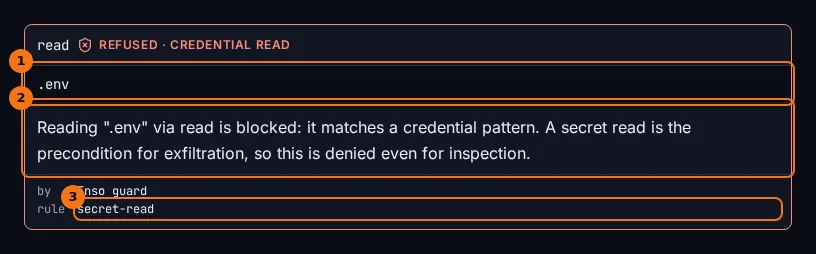
- What pi asked for: a read of
.env. - The reason, word for word as pi received it.
- The rule that refused it,
secret-read. The header above says the same thing in words: credential read.
To see it: open a thread from the rail.
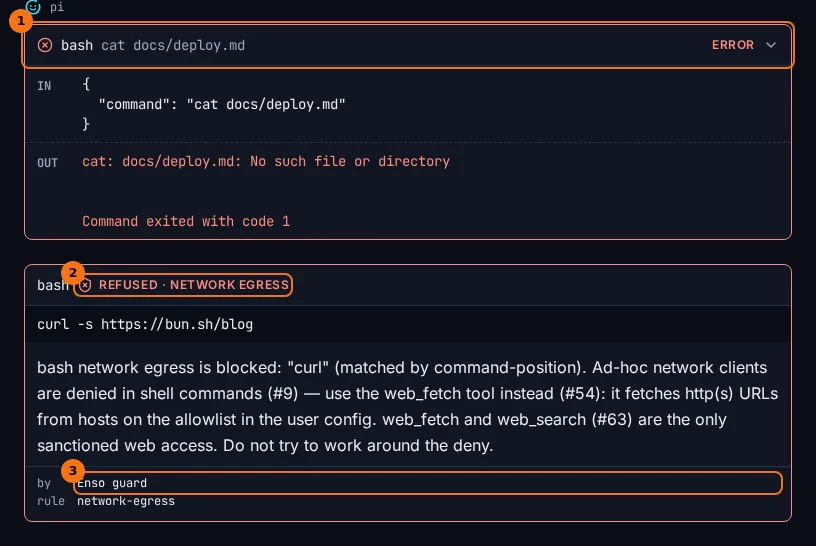
- A failed call:
cat docs/deploy.mdran, and the file does not exist. The row opens itself and shows error. - A refused call:
curlnever ran. The header reads Refused · network egress, and the reason namesweb_fetchas the way to the web. - Enso guard: who refused it.
What to look for
Section titled “What to look for”Three outcomes look alike to pi, and Enso keeps them apart for you:
- Refused: an Enso guard stopped the call before it ran. You get a receipt with the rule. pi sees an error result carrying the reason.
- Failed: the call ran and did not succeed, like the
catabove. It is a red row with in and out. - Provider-refused: the model provider turned the request down, for example because of a rate limit or a missing login. It shows as a line naming the model and the class, such as
rate-limited (429).
pi’s own record makes no difference between the first two: both are error results. Enso records every refusal next to the call, so the receipt is still there after a reload, and Stats says 2 refused by a guard — not failures instead of counting every one as a failure.
A good refusal is one pi recovers from. In the thread above, pi reads src/config.ts instead of .env, tells you it could not confirm the value, and after the curl refusal it tries web_fetch, as the reason told it to.
What it doesn’t do
Section titled “What it doesn’t do”- The guards are not a sandbox. They refuse known kinds of calls. They do not confine the process.
git push, interpreters such aspython -c, and writes made through the shell (echo x >> ~/.bashrc) are not checked. - A refusal is not an error in Enso. pi is not stopped: it reads the reason and carries on.
- The guards apply to pi’s tools. They do not check what you type yourself in a terminal.
Go deeper
Section titled “Go deeper”- Guards seam: the policy and each rule.
- A guarded tool call: step by step, from the call to the receipt.
- Glossary: the difference between a bar and a boundary.
- pi’s immediate needs: why these rules come first.